
If you’re considering a prenup—or already have one—you’re probably wondering: “Is this actually going to hold up in court?” Not all prenups are enforceable in California. The difference comes down to a few critical factors that determine whether the document is a shield or just a piece of paper.
California Doesn’t Automatically Enforce Prenups
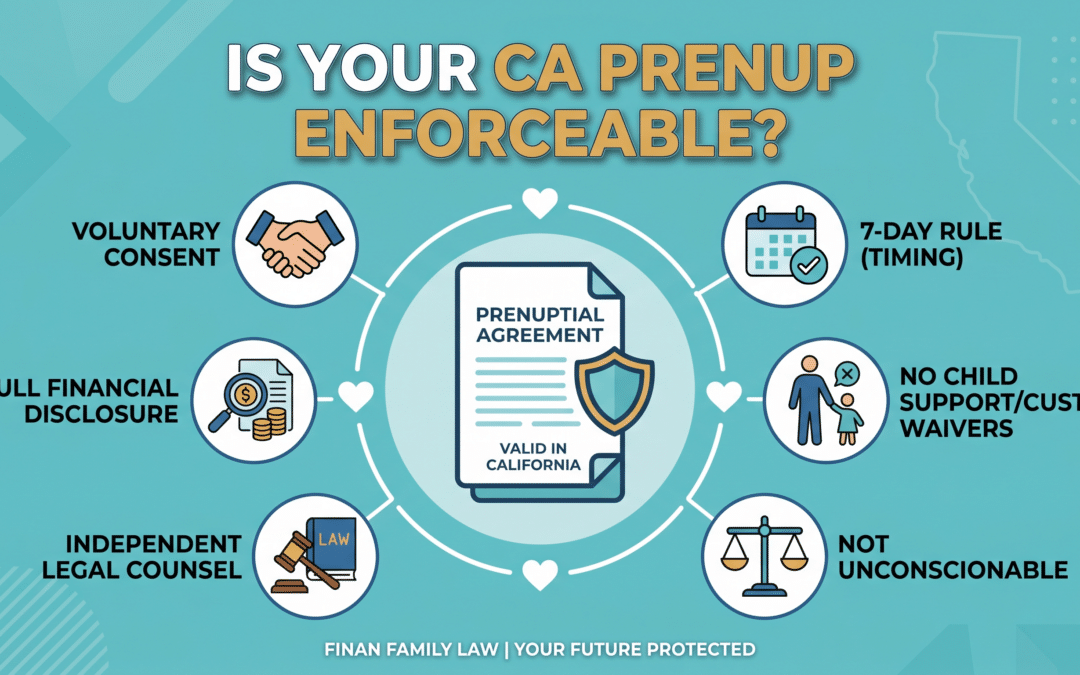
In the eyes of California courts, a prenuptial agreement isn’t a “set it and forget it” contract. Judges look for specific legal standards to ensure the agreement is legitimate. Courts primarily look at:
-
Voluntariness: Was it signed freely?
-
Full financial disclosure: Did everyone show their cards?
-
Fairness: Is the agreement “unconscionable”? If these elements are missing, the prenup can be invalidated during a divorce.
1. It Must Be Signed Voluntarily
For a prenup to be valid, both parties must enter into it without coercion. Red flags include:
-
The “Wedding Day” Surprise: Signing right before the ceremony.
-
Pressure or Threats: Feeling forced to sign to ensure the wedding proceeds.
-
No Time to Review: California generally requires at least 7 days between the final presentation of the agreement and the actual signing.
2. Independent Legal Counsel
Having separate attorneys is one of the best ways to strengthen enforceability. In fact, if the agreement includes a spousal support waiver, California law essentially requires that the party waiving support was represented by independent counsel at the time of signing.
3. Full Financial Disclosure
Transparency is non-negotiable. Each party must provide a complete list of assets (real estate, bank accounts, stocks), debts (student loans, mortgages), and income. Failure to disclose a “hidden” asset can be grounds for a judge to throw the entire agreement out.
4. Terms Cannot Be Unconscionable
California courts will not enforce agreements that are “unconscionable” at the time of signing. This typically means agreements that are so extremely one-sided that they create an unfair hardship or were signed without proper knowledge of the other person’s wealth.
5. Spousal Support Waivers
Provisions regarding alimony (spousal support) are closely scrutinized. These may be found invalid if the person giving up support didn’t have their own lawyer, or if the terms have become “unconscionable” by the time the marriage ends.
6. Child Support and Custody
It is a common misconception that you can plan for your children in a prenup. In California, child support and custody cannot be predetermined. The court always retains the power to decide what is in the “best interest of the child” at the time of the split.
Real Talk: Common Pitfalls
Even with the best intentions, prenups fail for simple reasons like using generic online templates, rushing the process a week before the wedding, incomplete financial disclosures, or drafting terms that are wildly one-sided.
What a Strong Prenup Looks Like
-
Full disclosures: Everything is on the table.
-
Independent counsel: Both partners have their own legal advocate.
-
Proper timing: No one is rushed; the 7-day rule is respected.
-
Clear terms: No ambiguous language.
-
Fair provisions: The agreement is realistic for both parties.
Bottom Line
A prenup is only as strong as the process used to create it. Done right, it provides peace of mind and protection. Done poorly, it provides a false sense of security.
Need Help?
Finan Family Law creates enforceable, strategic prenups for professionals and high earners. Schedule a consultation today to ensure your future is protected with clarity. For clarity, call Finan Family Law, APC at (424) 419-3067 or Click here to send us a request.
Finan Family Law, APC
Family Law Attorney
Serving the South Bay & Los Angeles County