
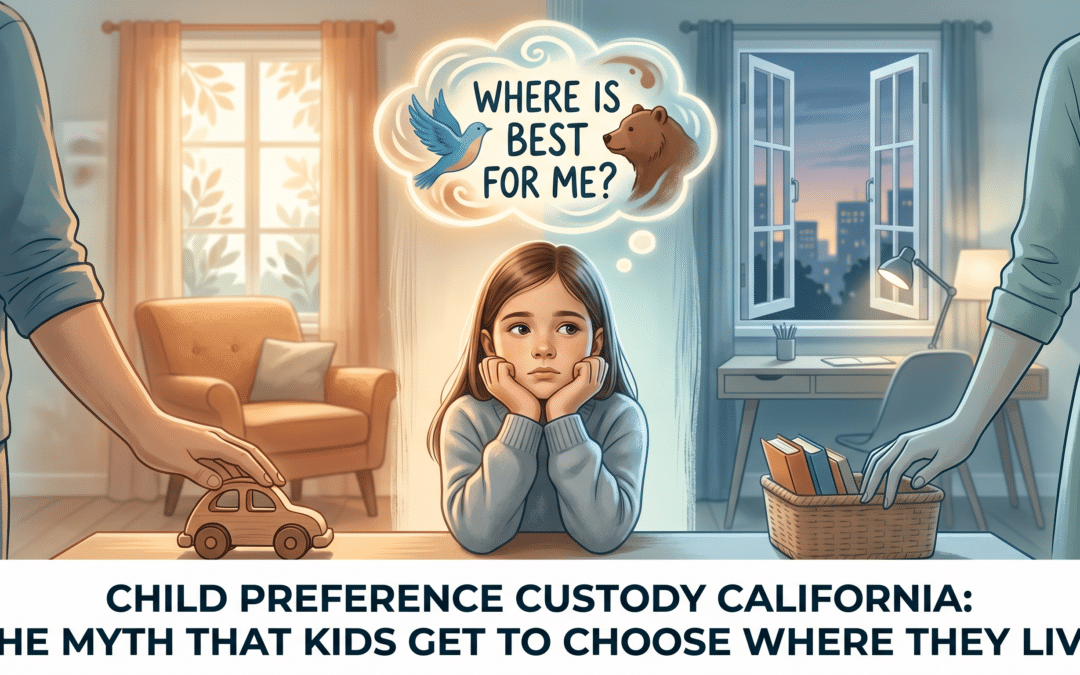
One of the biggest myths in California family law is that children get to choose which parent they want to live with. I hear this from parents all the time, and unfortunately, it simply is not true.
One of the most common questions I hear from parents during a California divorce or custody case is:
“Can my child choose which parent to live with?”
The short answer is no.
I know that is not always the answer parents want to hear. In fact, many parents come into my office convinced that once a child reaches a certain age, the child gets to decide where they want to live. That is one of the biggest misconceptions in California family law.
As a California family law attorney, I can tell you that courts do not hand custody decisions over to children. Nor should they.
If you are searching for information about child preference custody California laws, here is what you need to know.
Why Children Do Not Get to Choose
Children should not be placed in the middle of their parents’ custody dispute.
Divorce is already difficult enough for kids. Asking a child to choose between Mom and Dad places an enormous emotional burden on them. It can create guilt, anxiety, loyalty conflicts, and long-term emotional harm.
Think about what that question is really asking a child:
“Which parent do you love more?”
That is not a fair position for any child.
California courts recognize this reality. The law focuses on the child’s best interests, not on forcing a child to make a decision that adults are struggling to make themselves.
What Does California Law Say About Child Preference Custody?
Under California Family Code Section 3042, a court may consider a child’s wishes regarding custody or visitation if the child is of sufficient age and capacity to form an intelligent preference.
Notice what the law says:
-
The court may consider the child’s preference.
-
The law does not say the child gets to decide.
Even when a child expresses a preference, the judge must still determine whether following that preference is in the child’s best interests. The child’s wishes are only one factor among many.
Is There a Magic Age When Children Get to Decide?
No.
There is no age in California where a child automatically gets to choose which parent to live with.
While California law provides that children who are 14 years old or older may generally be allowed to address the court regarding custody preferences, the judge still has the final say.
-
A 14-year-old does not get veto power.
-
A 16-year-old does not get veto power.
The court remains responsible for making decisions based on the child’s best interests.
Why It Is Wrong for Parents to Ask Children to Choose
This is where I am going to be very direct: Parents should not be asking children to choose sides.
I have seen parents intentionally or unintentionally pressure children into expressing a preference. Sometimes it comes from a place of fear. Sometimes it comes from anger. Sometimes it comes from a desire to “win” the custody case. None of those reasons justify putting a child in the middle.
When children feel pressured to choose, they often:
-
Tell each parent what they think that parent wants to hear.
-
Carry guilt for hurting the other parent’s feelings.
-
Become anxious or withdrawn.
-
Feel responsible for adult problems.
-
Experience damage to their relationship with one or both parents.
Children deserve to be children—not witnesses, decision-makers, or tie-breakers in their parents’ divorce.
What Alternatives Are Available?
If a child’s thoughts and feelings need to be heard, California courts have several alternatives that avoid forcing a child to directly choose between parents.
1. Child Custody Evaluations
A custody evaluator can interview the child, parents, and other important individuals involved in the child’s life. The evaluator then provides recommendations to the court regarding what arrangement serves the child’s best interests.
2. Minor’s Counsel
The court can appoint a lawyer for the child, known as Minor’s Counsel. This attorney represents the child’s interests and can communicate the child’s concerns to the court without forcing the child into the middle of the conflict.
3. Child Interviews Conducted Properly
In certain cases, a judge may speak with a child or allow the child’s views to be presented through appropriate procedures. This is done carefully and under court supervision—not through pressure from either parent.
4. Co-Parenting and Mediation
Many custody disputes can be resolved through mediation and cooperative co-parenting rather than putting children in the position of making decisions.
What Matters Most to California Courts?
The court’s focus is always the child’s best interests. Factors may include:
-
The child’s health, safety, and welfare.
-
The nature of each parent’s relationship with the child.
-
Stability and continuity.
-
Any history of abuse.
-
The ability of each parent to support the child’s relationship with the other parent.
-
The child’s wishes, when appropriate.
No single factor controls the outcome.
Final Thoughts
If you are involved in a California custody dispute, resist the temptation to ask your child to choose between parents. That is a burden children should never have to carry.
The better question is not, “Who does my child want to live with?”
The better question is, “What arrangement is truly in my child’s best interests?”
California courts take that responsibility seriously, and so should parents.
If you have questions about child preference custody California laws or are facing a custody dispute in Los Angeles County, Torrance, Redondo Beach, Manhattan Beach, Hermosa Beach, Palos Verdes, Long Beach, San Pedro, or the surrounding areas, Finan Family Law, APC can help.