
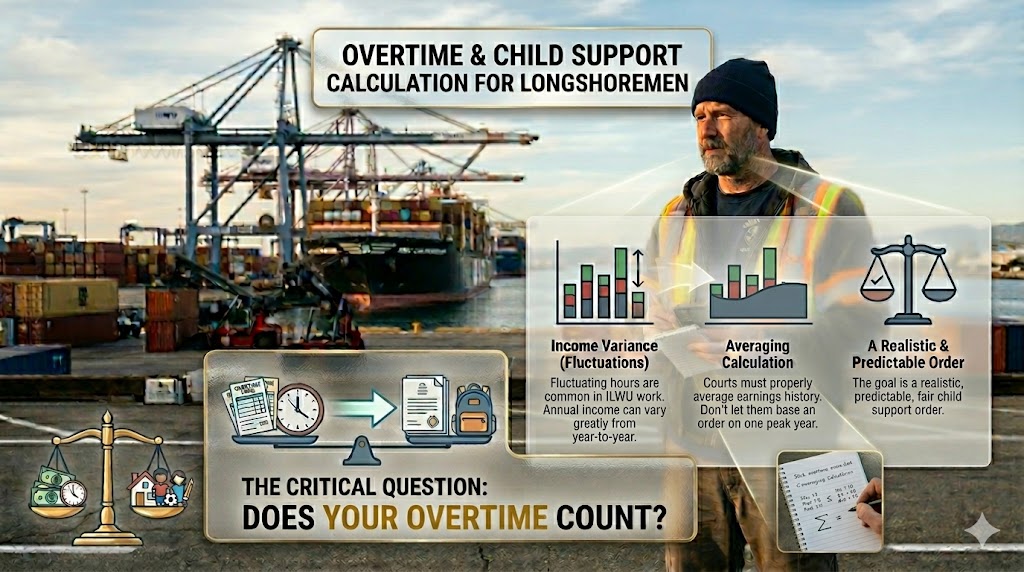
If you are a longshoreman going through a divorce or child support case, one of the biggest questions you may have is:
“Will my overtime count for child support?”
The answer is: it depends.
As a California family law attorney, I work with many ILWU longshore workers and families dealing with child support issues. One of the unique challenges longshoremen face is that income can fluctuate dramatically from month to month and year to year.
Some years include significant overtime earnings. Other years may look very different.
Understanding how California courts treat overtime income is critical if you want a child support order that is fair, realistic, and based on your actual earning circumstances.
What Is Overtime Income?
Overtime is compensation earned above a worker’s regular schedule. For longshoremen, overtime may include:
-
Night shifts
-
Weekend work
-
Holiday work
-
Casual shifts
-
Extra dispatch opportunities
-
Extended hours during busy cargo periods
Because overtime can represent a substantial portion of a longshoreman’s income, it often becomes a major issue when calculating child support.
Does California Count Overtime for Child Support?
Generally, yes.
California child support laws require courts to consider a parent’s income from all sources. Overtime earnings can be included when calculating support. However, the analysis does not stop there.
The real question is whether the overtime is consistent, predictable, and likely to continue. California courts are supposed to look at a parent’s actual earning circumstances—not simply pick the highest income year and assume it will continue forever.
Why Overtime Creates Problems for Longshoremen
Many longshoremen do not earn the same amount every year. Work opportunities can fluctuate based on:
-
Port activity
-
Labor demands
-
Economic conditions
-
Dispatch opportunities
-
Seniority
-
Health issues or injuries
-
Contract changes
A longshoreman may have an exceptional year followed by a much lower-income year. Unfortunately, I often see support calculations based on a single high-income period that does not accurately reflect future earnings. That can create child support orders that become impossible to maintain.
Can a Court Average Overtime Income?
Yes. In many cases, courts will review multiple years of earnings and calculate an average. This is often one of the fairest approaches for longshore workers because it smooths out unusually high or unusually low years. Rather than focusing on one exceptional year, the court can evaluate a broader income history. The goal should be a realistic picture of earning capacity.
Can Overtime Be Excluded?
Sometimes. California courts have discretion to consider whether overtime income should be treated differently under the facts of a particular case. For example:
-
The overtime may be unusual or temporary.
-
The worker may no longer be physically capable of working excessive overtime.
-
Economic conditions may have changed.
-
Port activity may have declined.
-
The overtime may have resulted from extraordinary circumstances that are unlikely to repeat.
Every case is fact-specific.
What Evidence Is Important?
If overtime is an issue, documentation matters. Important records may include:
-
Tax returns
-
W-2s
-
Pay stubs
-
Payroll records
-
Dispatch records
-
Historical earnings reports
-
Medical records if health affects work availability
The more information available, the easier it becomes to demonstrate whether overtime is regular income or an unusual spike.
What Happens If Overtime Drops After the Order Is Made?
This is another issue I see frequently. A child support order may be based on income that included substantial overtime. Later, the overtime opportunities disappear.
When there has been a significant change in circumstances, a parent may be able to seek a modification of child support. Waiting too long can be costly. Child support generally does not automatically adjust when overtime disappears; a formal request for modification is usually required.
The Biggest Mistake Longshoremen Make
The biggest mistake I see is assuming that because overtime fluctuates, it will not be considered. That is simply not true.
The second biggest mistake is assuming that a support order based on unrealistic overtime income cannot be challenged. In many situations, there may be legal options available to obtain a more accurate support calculation.
Final Thoughts
California child support cases involving longshoremen are rarely straightforward. The unique nature of ILWU work, dispatch opportunities, fluctuating overtime, and variable annual income requires a careful analysis of the facts. The question is not simply whether overtime counts. The real question is whether the support calculation accurately reflects the longshoreman’s true earning circumstances and future income potential.
If you are an ILWU longshore worker facing a child support issue in Torrance, San Pedro, Long Beach, Wilmington, Los Angeles County, or the surrounding areas, it is important to understand how overtime earnings may impact your support obligation and what options may be available if your income has changed.
At Finan Family Law, APC, we regularly work with longshoremen and understand the unique financial issues that arise in California child support cases.